
Indications
See how Guided DolorClast® Therapy can help across the body
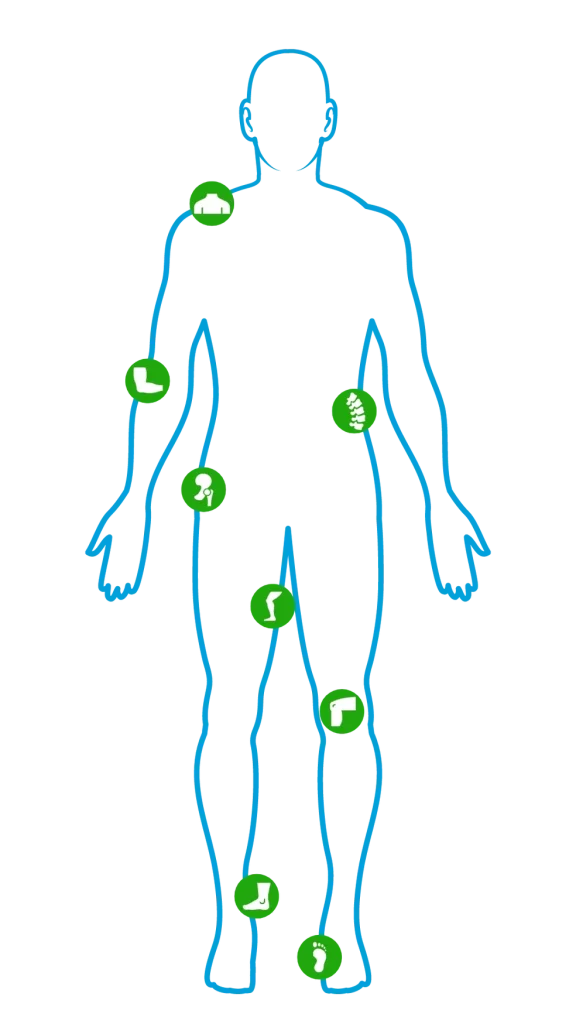
Using Guided DolorClast® Therapy, you can effectively treat up to 90% of musculoskeletal system issues.
Click on the below body part list to see more information
Foot
Plantar Fasciopathy
Plantar fasciopathy (PF) is an acute or chronic, painful disorder of the plantar fascia that spans between the medial calcaneal tubercle and the proximal phalanges of the toes.
Marrow Oedema
Bone marrow oedema occurs when fluid builds up in the bone marrow and is typically a response to an injury, such as a fracture or condition such as osteoarthritis. Although pain is the major symptom, bone marrow edema differs in terms of its causal mechanisms, underlying disease, as well as treatment and prognosis.
Ankle
Insertional Achilles Tendinopathy
The Achilles tendon is the combination of tendons of the soleus and gastrocnemius muscles and connects these muscles to the back of the heel. Insertional Achilles tendinopathy (IAT) is a painful acute or chronic disorder of the Achilles tendon at its insertion onto the calcaneus. Several terms have been used to describe this condition including tendinosis, tendinitis and peritendinitis.
Midbody Achilles Tendinopathy
The Achilles tendon is the combination of tendons of the soleus and gastrocnemius muscles and connects these muscles to the back of the heel. Mid-portion Achilles tendinopathy (MPAT) is a painful acute or chronic disorder of the Achilles tendon.
Knee
Patella Tip Syndrome
The patellar tendon connects the lower pole of the patella to the tibia. Patellar tendinopathy (PT), often referred to as jumper’s knee, is a chronic overuse injury of the patellar tendon.
Medial Tibial Stress Syndrome
Medial tibial stress syndrome (MTSS) -commonly known as ‘‘shin splints” – is a frequent overuse injury or repetitive-stress injury of the lower extremity.
Hip
Greater Trochanteric Pain Syndrome
Greater trochanteric pain syndrome (GTPS) includes a number of disorders of the lateral peritrochanteric space of the hip such as tears of the gluteus medius and minimus, trochanteric bursitis, and external coxa saltans.
Greater trochanteric pain syndrome has been reported to affect between 10% and 25% of the general population, with an increased prevalence in women compared to men.
Radial shock wave therapy has been demonstrated to be efficient for recalcitrant greater trochanteric pain syndrome.
Back
Upper Back Pain
Tension-type headache (TTH) is characterized by a bilateral, pressing, tightening pain of mild to moderate intensity, and is the most featureless of the primary headaches
Lower Back Pain
Lower back pain without sciatica, stenosis or severe spinal deformation (henceforth referred to as idiopathic lower back pain, ILBP) is common and affects people of all ages. It is second only to the common cold as the most common affliction of mankind and is among the leading complaints bringing patients to physicians’ offices.
Elbow
Golfer’s Elbow
Golfer’s elbow is a tendinopathy of the medial epicondyle of the elbow. It is in some ways similar to tennis elbow.
Tennis Elbow
Tennis elbow is a tendinopathy of the common extensor origin of the lateral elbow. In former times the condition was usually named “lateral epicondylitis”. However, the pathology is no longer thought to be inflammatory. Nowadays the accurate description would be “partially reversible but degenerative overuse-underuse tendinopathy”. Because of the complexity of this description, the term “tennis elbow” is usually used.
Shoulder
Calcifying Tendinitis Of The Shoulder
Calcifying tendinitis of the shoulder is a painful acute or chronic disorder characterized by calcifications in rotator cuff tendons.
Subacromial Pain Syndrome
The term subacromial shoulder pain is often used synonymously with the terms rotator cuff disease, rotator cuff tendinosis, and shoulder impingement syndrome.
Advanced Pain Relief with Guided DolorClast Therapy.
A better combination
What is Guided DolorClast Therapy (GDT)?
Guided DolorClast Therapy (GDT) is an innovative approach combining shock wave therapy with high-power laser treatment to offer superior pain relief and promote faster healing. Developed by EMS, this integrated therapy targets both superficial and deep tissues, providing a comprehensive solution for various musculoskeletal conditions.
How Does It Work?
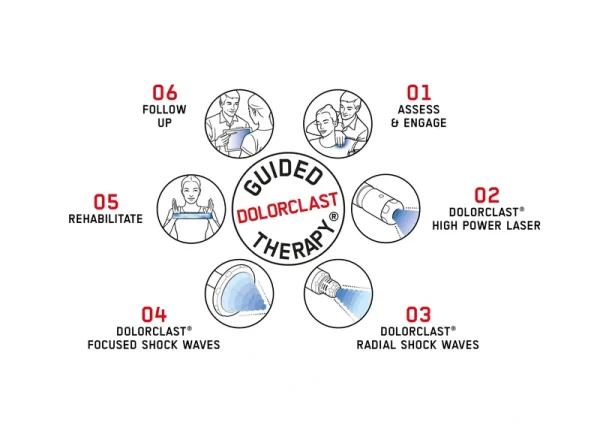
GDT involves the application of high-power laser therapy followed by radial shock wave therapy. Here’s a breakdown of the process:
- High-power Laser Therapy: Utilises a 905nm wavelength and high peak power of 300W, penetrating deep into tissues without causing burns. This step enhances blood circulation, reduces inflammation, and promotes tissue regeneration.
- Shock Wave Therapy: After a short pause, radial shock waves are delivered to the affected area. The mechanical energy helps break down scar tissue and stimulate cellular repair, providing pain relief and improving function.
- Benefits of GDT
Enhanced Pain Relief: GDT offers more effective and long-lasting pain relief by combining laser and shock wave therapy.
Faster Healing: The synergistic effect of the therapies accelerates tissue repair and recovery.
- Versatile Applications: Suitable for a wide range of conditions, including plantar fasciitis, tendonitis, calcific tendonitis, and chronic wound healing.
Non-Invasive: This treatment is non-invasive and can be performed without anaesthesia, ensuring patient comfort and safety.
Explore More
Download our comprehensive brochure for detailed information about EMS Guided DolorClast Therapy. Discover how this advanced therapy can enhance your clinical practice and improve patient outcomes.
Explore More
Our team is here to answer any questions you may have and provide guidance on integrating GDT into your treatment protocols.
Contact us today to learn more and discuss how EMS Guided DolorClast Therapy can benefit your patients.